
2 Min Drill
Ready to Run a Two-Minute Drill?
A real situation, four call families and one snap button. Read the defense, pick the play, and see what the call was worth.

Ready for the snap
2 Minute Drill
Press Play 2 Minute Drill to load the browser game iframe.
Controls: tap the call buttons, or use the number keys. Space skips the kickoff animation.
2 Minute Drill Online: Read the Defense, Make the Call
2 Minute Drill is a football play-calling game built on one tension. A real drive is a sequence of fast decisions made with almost no time to make them. You get a down, a distance, a clock and a defense, then four buttons: run, pass, RPO or trick. Pick one, watch the snap, live with the result. The browser version is free, needs no install, and can be added to a phone home screen as an app.
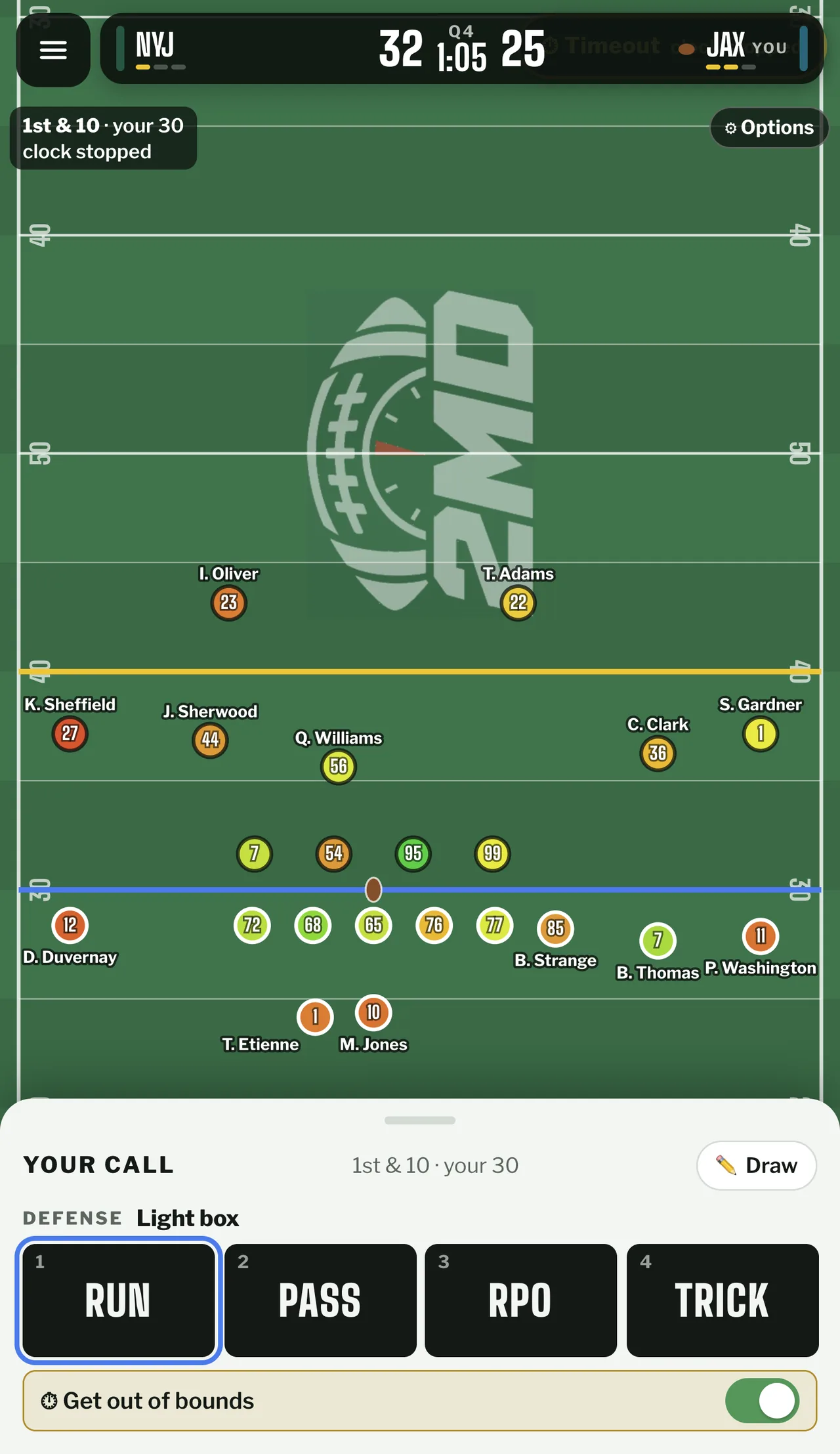
What makes it a rhythm game rather than a quiz is the situation. The scenarios come from real games, so the score, the quarter, the down and the seconds are all fixed before you touch anything. In one captured frame the Jets trail 32-25 with 1:05 left in the fourth, first and ten on their own 30. Nothing about that is yours to choose. All you control is the next call and how quickly you make it.
This site is about presses landing in the right window. Here the press is a call and the window is the gap between snaps, which makes this the slowest game on the site and the one where a bad tempo is easiest to see.
The Clock in 2 Minute Drill: 740 Situations, One Decision at a Time
Every situation is fixed before you call anything: score, quarter, down, distance, field position and clock. The rules page puts the library at 740 situations; the build's own data file lists 744 entries. The difference is small enough to be bookkeeping rather than a different game. What matters is that you never pick the situation. You only pick the call.
That is where the pace comes from. A Survivor drive hands you downs in sequence, each with four families and a snap button, and the next down arrives as soon as the play resolves. Six or seven of those in a row is a two-minute drill, and the two minutes are only the container. The decisions are what fill it.
The result screen is the part that changes how fast you play the next one. It grades the call separately from what the play produced, which shortens the loop: you do not have to argue with yourself about whether the incompletion was your fault before you can move on.
2 Minute Drill Screenshots: Read, Select, Result
2 Minute Drill Controls: Number Keys, Space and the Snap Button
- 1The strip at the top carries score, quarter and clock. The box at the top left carries down, distance and field position, plus whether the clock is running. The defense gets a name of its own on the call sheet, light box in the captured frame, which tells you what the four options are working against.
- 2Run, pass, RPO and trick sit on four large buttons, each numbered. Pressing the number is as quick as clicking and keeps your eyes on the field instead of the cursor. (1 to 4, or click)
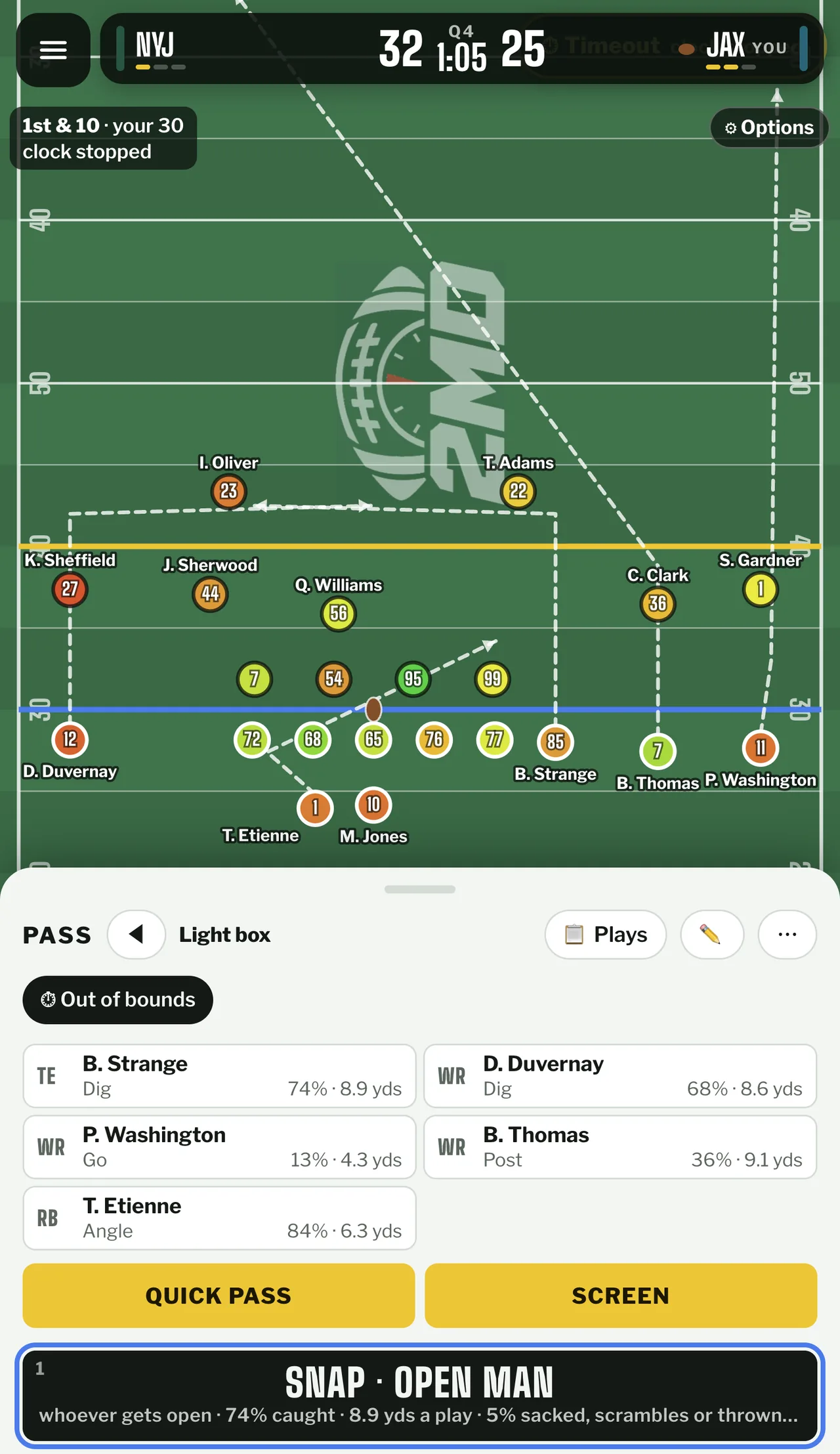
- 3On a pass the sheet lists eligible receivers with their route and a catch rate. In the captured frame the tight end on a dig shows 74 percent and 8.9 yards a play, while a receiver on a go shows 13 percent and 4.3 yards. The number keys 1 to 9 are bound to the numbered buttons, so a key can carry you from the call to the snap without reaching for the mouse. (1 to 9)
- 4The full-width button at the bottom starts the play and carries its own number, 1 in this frame. On the receiver screen that same key completes the snap, and it is the only irreversible input in the sequence. (1, or the wide button)
- 5Space jumps the kickoff animation. It does not skip the play, and it does not skip a snap. On a repeat Survivor run this is the difference between a drive that feels brisk and one that feels like waiting. (Space)
- 6Tab moves between buttons and Enter selects. The entire sheet is reachable from the keyboard, which matters on a laptop trackpad that keeps drifting mid-drive. Once the keys are under your fingers, the mode you pick matters less than the pace you keep in it. (Tab / Enter)
Daily, Survivor, Versus and Pro: Four Different Paces
Daily
One situation a day. The habit mode, and the one where a single call carries the most weight because there is no next down until tomorrow.
Survivor
Drives strung into a streak. This is where tempo matters most, because the run keeps going as long as the calls keep working, and every kickoff you sit through is dead time in a streak you are trying to extend.
Versus
The head-to-head mode. The call sheet keeps the same four families, so the pace you build in Daily or Survivor carries straight over to it.
Pro
A one-time 4.99 dollars. Launch coverage says it opens past dailies and historical situations, which matters if the 740-situation library is the reason you are here rather than the daily habit.
Your Call Was Fine: Reading the Line Under the Result
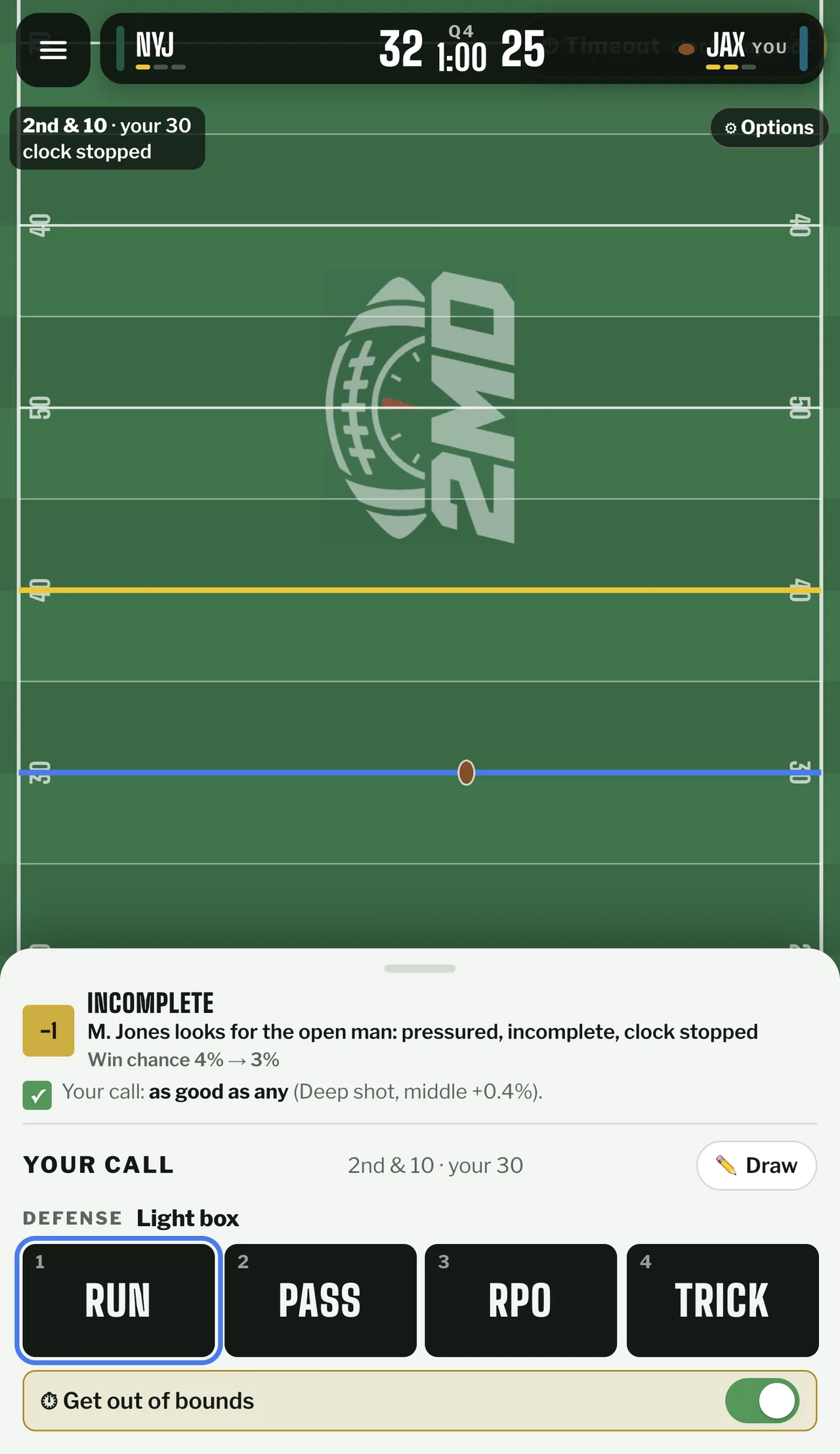
The result card does two jobs at once. It tells you what happened, incomplete, minus one, clock stopped, and it tells you whether the call was reasonable: as good as any, with a percentage attached to what you passed up. In the frame captured here a deep shot to the middle graded plus 0.4 percent while the win chance slipped from 4 to 3.
That second line is unusual in a sports game, and it changes the rhythm of a losing run. A bad result stops being evidence of a bad decision, so the next call does not have to be a correction. You can call the same way again and let the percentages work.
It also makes the game easier to learn than a pure outcome game. Losing a drive to an incompletion still leaves you with a grade, and a grade is repeatable in a way that a scoreboard is not.
2 Minute Drill Tips: When the Catch Rate Should Change Your Mind
The catch rates are the only numbers on the call sheet that describe the future, so they deserve most of your attention.
One more point about patience. The game is free and a daily is short, so the temptation is to burn through situations to see more of them. The grade line rewards the opposite: a small number of well-read calls teaches more than a large number of fast ones.
- Prefer the high-percentage route when the clock is the constraint. 84 percent at 6.3 yards keeps the chains moving; 13 percent at 4.3 does not.
- Treat the four families as risk bands, in football terms rather than game terms. Run is the low-variance call and trick is the one that either breaks the drive open or ends it.
- Use the grade, not the result, to decide what to change. If the grade says the call was fine, changing it is a reaction to noise.
- Skip the kickoff. Every second spent watching a kickoff is a second not spent on the next read.
2 Minute Drill FAQ
Games Like 2 Minute Drill for a Quick Decision
If the draw is a fixed clock and one call deciding the next few seconds, these three on the same site run the same shape.


